Showing posts with label Week 2. Show all posts

Sunday, February 7, 2021

Thoughts on Feedback

 Feedback Articles

Headache touching forehead.jpg

(Image Source: Wiki Commons)

One aspect of the article "A Fixed Mindset could be Holding you Back at Work" by Anna Kelsey-Sugg and Ann Arnold, that I found most interesting was how excessive positive feedback results in a brittle person incapable of overcoming adversity. The part of this most intriguing was the usage of the word brittle, primarily for the mental image it conjures of one's mind literally breaking. Having come from an environment which was most definitely contributing to excessive positive feedback, I can understand how accurate this image it. Oftentimes when confronted with. a situation where one does not believe that a chance at success exists, it is very easy to simply shut down. and this applies even more in situations of feedback where it appears as if someone is actively criticizing your work. In those situations, it is antural to throw up barriers both to defend oneself from criticism and to help keep you form having to do the thing which you were criticized for in the first place ever again. 

Retaliation to negative feedback is a prominent theme in Tim Herrera's article "Why it's so Hard to Hear Negative Feedback" and focuses primarily on people's defensiveness in the face of negative feedback. In the article, Herrera cites several studies which show people actively avoid feedback for fear of getting critiqued. The primary reason for this, as the studies suggest, is because people do not tend to believe that other are actually actin in good faith. Instead, they fear that people are being overly critical with the intent of tearing one another down. From personal experience, I can wholly understand this sentiment. When a peer edits your paper, one's inclination at the first critique is to see how they were wrong to say what they did and to defend your own answer; not because they necessarily are wrong, but because the very fact they say there is something which needs editing implies they are trying to critique the person and not the paper. 

Friday, February 5, 2021

Topic Brainstorm

 Topic 1: Underworld Stories

Image result for cave images

(Image Source: Glowworms Cave)

Across every ancient culture and many modern cultures is the belief in an afterlife or underworld. In each culture there were different requirements for the entering into a "good" afterlife and a "bad" afterlife. In this project I would like to create a fable about an individual who Death incarnate has taken a special interest in because even Death does not know where this person's soul belongs after death. I would like to use this as a framing narrative to explore and explain the nuances and niches of different Underworlds. I will most definitely be using the Greek version of Death as my tour guide of the Underworlds (using the less-than-common depiction of him as a handsome youth) but am open to tweaking his character based on the details of other Underworlds. Tentatively I plan on visiting Hel/Valhalla (Norse), Elysium/Asphodel (Greco-Roman), Mictlān/Tlalocan (Aztec), and Lua-o-Milu (Hawiian). 

Topic 2: Ageless Bystander

There have been innumerable moments in time historians would die to be able to witness and know actually what happened and what part of the myths may be true and which were simple fantasy. I would like to create a new story with a new ageless character who has been able to witness some of these truly unknowable events and create my own version of events that actually happened there. One of these stories has to be the tale of Atlantis, as it is one of the most hotly debated tales from mythology as to its validity in history. Other stories I would like to research and include are the Trojan War, the Battle of the Horatiī and Curatiī, and the truth of the Roanoke Island Colony. It is likely that none of these mysteries will ever be solved, so I am not afraid of taking some creative liberty and building on some of the most wild speculations of those myths and tying all of them to gather through the eyes of this character who has lived to witness it all.

Topic 3: Thousand and One Nights Retelling

Some of my favorite stories that I have heard in recent years have been those included in One Thousand and One Nights. I would like to to chose four of my favorite stories and retell them in a way very similar to our weekly Anthologies. Of the stories in Arabian Nights, I plan on including at least one Sinbad tale, the tale of the Valley of Diamonds being the most likely. Besides that one story, I do not know which stories from Scheherazade I would like to retell mostly because I like so many of the stories. I plan on skim reading through several of the stories in the next few days to get a rough grasp of which I like the most before I commit to any one of them.

Topic 4: Civilization Building Gods 

Many mythologies tell of gods who helped cultivate early human civilization, guiding them towards a stronger future. These gods are often forgotten when compared to the powerful nature gods like Zeus and Poseidon or the primordial gods like Hades and Demeter. These civilization creating gods are much more nuanced and focus on helping humanity grow in very specific ways that vary between civilizations. One of the most prominent examples of these Builder Gods is Prometheus, not technically a god but fulfills this role, as he brought fire to mankind to help them grow. Other gods which I would like to retell their story is Thoth of Egyptian mythology and how he was assigned the task of creating hieroglyphs for men to remember their past, Xipe Totec (Aztec agriculture deity) who would sacrifice himself so that mankind would have seeds to sow for their yearly harvest, and the Hindu god Ganesha who is the overseer of all beginnings and his efforts to aid the enterprises of men.

Thursday, February 4, 2021

Week 2 Story: Beauty and the Basilisk


The Three Roses 

Once there was a mother who lived alone with her three daughters. Her husband having passed away some years ago the mother worked arduously to provide for her family. She mended neighbors’ clothes, grew herbs on their small plot of land, and even worked occasionally at the local tavern, all to help support her daughters.

It was one night working at the tavern that a visitor to the small community left a sizable tip for her. Ecstatic at the gift, she returned home to her girls. When she arrived home, she became determined to use the money to give her daughters gifts, a largely absent commodity. She asked the oldest daughter what she wanted and the girl immediately spouted out a long list of things she had always dreamed of owning. Unabashedly, the second daughter replied with a list very similar to her elder sister’s. 

Beginning to fear that the tip would not be large enough to cover the desires of the girls, the mother turned to the third and youngest daughter. This girl claimed to be content with the provision of her mother and wanted nothing more. Surprised, the mother asked again and was then told that if the mother insisted on a gift, let it be three simple roses.


Her head whirling with the oddity of the night and trying to remember the lengthy lists two of her daughters provided, she went to bed with the intention of going to the market in the nearby city the next morning. The market within held everything on the lists of the two older girls and the money left to the mother by the traveller was barely sufficient to cover the gifts. Heavy laden, the mother began her trek back home as dusk fell.

On the road home the realization that she had forgotten the simplest of gifts for her youngest daughter overtook the mother. In guilty desperation, she cast her gaze to the countryside around her. In unbelievable luck, she had stopped next to a large estate on the roadside with a magnificent garden. Thinking that the master of the house would not miss three simple flowers, the mother snuck into the garden. 

Within she found the most beautiful of rose bushes. Quickly, she cut three of the largest off and turned to leave the garden. However, standing in the gateway was a large basilisk who stared at her with large, yellow eyes. The basilisk spoke and made a demand of the mother to either give her own life or to bring her daughter here as a price for the roses. Trembling with fear, the mother hastily agreed to bring a daughter to the beast the very next day.

At that, the mother fled from the garden as quick as her feet allowed. Once home, she hurriedly explained to her youngest daughter the agreement, while the older two excitedly rifled through the pile of gifts. Quite surprisingly, the young girl agreed to go with her mother the next morning, an air of calm emanating from the child. Flustered by the whole scenario, the mother went to bed with dread in her heart for the fate of her daughter and hate for her own cowardice.

Despite her misgivings, the next morning she gathered her daughter and her things, and they left for the estate. As they walked down the track, the mother determined she would make amends for her cowardice and save her daughter from the beast at the first opportunity. Once at the estate, the basilisk met them at the same gate as the night before and ordered the girl into the house and for the mother to leave. Crestfallen, the mother gave her daughter what she feared may be her final hug and left.

She did not go far, however, she merely walked down the track and then into the woods, and there waited for night to come. Once night had fallen, she crept back to the estate and peered through a large set of windows. Inside, she saw the most bizarre of scenes. Her daughter was very much alive but was holding the head of the beast in her lap as the rest of it lay curled on the floor. And so the two remained all night long. When the sun began to rise the mother fled the estate again, for fear of the beast and for lack of opportunity to rescue her daughter. 

She returned the same evening after having returned home and rested during the day. Much to her surprise, she found the same bizarre scene with her daughter and the beast. Astounded the beast had let the girl live this long, she returned yet again on the third consecutive night but, this time, to a much different scene.

Inside she heard the beast shouting at the girl to cut off his head with the sword the beast had drug into the room. The girl seemed reluctant as first, but the beast threatened her until she did as he bade. Despite the gruesome slaughter, the girl remained in the midst of the mess while a serpent slithered out of the decapitated corpse. As it slithered, it called out in the voice of the beast for the girl to strike his head off yet again. This time the girl did so without hesitation.

Relieved that the threat was gone, the mother prepared to enter the estate and pull her daughter from the ghastly scene as one final surprising thing happened. The bloody body of both the beast and the serpent melted away, as did the sword the girl was holding. In the place of the body stood a princely man.

He told the girl of a curse which had been placed on him many years ago that required a pure heart to break. He then asked the girl if there was any way he could repay her for breaking the curse. She replied with one simple phrase: “All I would like is three simple roses.”


Author’s Note

Reading the original story left me deeply unsatisfied as there was no explanation for many of the events which happened, such as why the mother was going to the town, and the motivations for all of the characters’ actions were never explained. I sought to add a little more detail to the events which surround the mother going to town in the first place and sought to generate a better understanding of one character by focusing on the mother’s perspective throughout the story. All that being said, I understand and appreciate the mysticism of a fantasy tale and tried to keep an air of that in my retelling by leaving the youngest daughter a mysterious enigma to everyone, as she was in the original story. 

(Image Source: Daron Hagen)

Story Source: The Three Roses by Josef Baudis in The Key of Gold

Wednesday, February 3, 2021

Reading Notes: Week 2 Anthology

 Beauty and the Basilisk

by Josef Baudis in The Key of Gold

Image result for basilisk images

(Image Source: Picryl)

Major Plot Points

  • Mother asks three daughters what gifts they would like from town
  • Oldest two ask for many and extravagant gifts
  • Youngest asks for nothing but three simple roses
  • Mother goes to town and buys all the gifts but forgets the roses
  • On return trip home through countryside she remembers 
  • She finds roses in the garden of a country estate
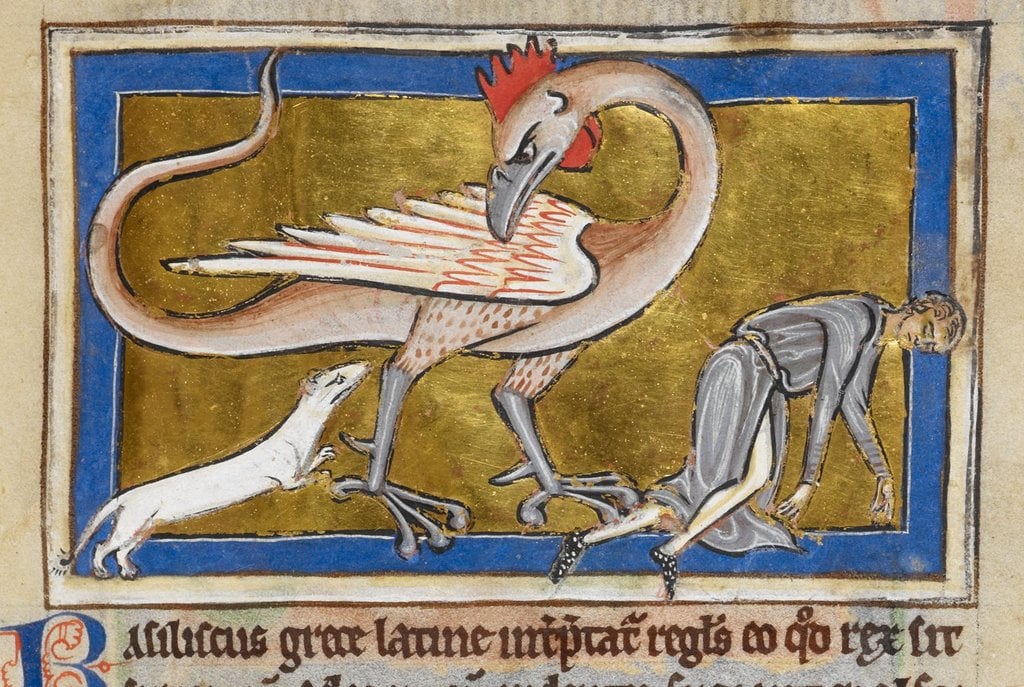
  • She is confronted by a fearsome basilisk who demands the mother's daughter as a price for the roses
  • Distraught, the mother returns home and tells her daughter the price for the roses
  • Surprisingly, the daughter agrees to go to the basilisk's home
  • Once there she is told that she must hold the basilisk in her lap for three nights or the beast will kill her
  • Confused she agrees to this 
  • On the third night the basilisk demands she take a nearby sword and cut the beasts head off
  • She refuses on account of her kind heart
  •  The basilisk issues a new round of threats which result in convincing the girl to kill the beast
  • Out of the decapitated beast's body slithers a snake which the girl also cuts the head off of
  • From this body comes a richly adorned prince who proceeds to ask the daughter for her hand in marriage as she had freed him form a curse
Themes
  • Wicked sisters
  • Pact with the beast
  • Ransomed daughter
  • Held hostage by the beast
  • Break the beast's curse

Tuesday, February 2, 2021

Week 2 Reading Overview

Reading Schedule 

Choose from CLASSICAL and/or BIBLICAL units for Weeks 3 and 4.

Week 3: Aesop (Jacob)

Week 4: Aesop (Winter)

Choose from MIDDLE EASTERN and/or INDIAN units for Weeks 5 and 6.

Week 5: Sinbad

Week 6: Ancient Egypt

Choose from ASIAN and/or AFRICAN units for Weeks 7 and 9. [Week 8 is review week.]

Week 7: Monkey King

Week 9: China Folktales

Choose from NATIVE AMERICAN units for Weeks 10 and 11.

Week 10:  Cherokee

Week 11: Great Plains 

Choose from BRITISH and/or CELTIC units for Weeks 12 and 13.

Week 12:  King Arthur

Week 13: Beowulf

Choose from EUROPEAN units for Weeks 14 and 15.

Week 14: Ashliman

Week 15: Russian
File:Coyote portrait.jpg - Wikimedia Commons
(Image Source: Wikimedia Commons)
I am so excited about so many of these units that's it's difficult to narrow it down to a few! Many of my choices on this list come from a podcast I listen to called Myths & Legends which narrates short versions of many folktales and mythologies. While I love this podcast, it often leaves the stories open-ended and leaving the listener wanting to know more. The reasons for this are understandable, one guy can only put out so much content a week; but it has left me desiring more from some of my favorites. 
Likely the two I am most excited to read are the stories of the Monkey King and of King Arthur. Both of these are quite large collections of stories and, as a result, have left me with much to be discovered in them. Additionally I am excited for the Cherokee and Great Plains stories for multiple reasons: foremost I believe that Native stories are quite unique and very underrepresented in culture, secondly I am both Cherokee and Osage and would like to know more about the stories of my ancestors! That is the main reason I chose the image I did for this post; the Coyote is often the trickster in Native stories and is one of my favorite characters from my scant interaction wit hNative tales.

Week 13 Story: The End of Beowulf

 A Tale from the Background Sven stared enviously at the pile of gold in the dragon's lair. Wiglaf had just commanded all of the earls, ...